Saturday, November 17, 2012

BUS600 ProSem: Chapter 9 - Strategy


Porter's Five Force
According to Harvard professor Michael Porter, an industry can be analyzed using a Five-Forces Model. These forces determine how intense competition is within a particular industry. Industries with low intensity, are considered attractive, as they are profitable.  

 
Value Chain - important analysis tool
Inbound Logistics: Vendors selection, net payment term, Shipping method
Operations - employee has the right skill, quality control, training
Outbound Logistics - how do you sell, lead time, delivery
Marketing & Sales
Services

Level of Strategy
Functional Strategy: Can we improve how to do operation?
Business Strategy: How can we beat the competition?
Corporate Strategy: What business should we be in?
BUS600 ProSem: Chapter 8 -  Economics

Below is a couple useful concepts I learned in the economics chapter.

  • Supply and Demand


  • Opportunity Costs - Opportunity cost is the cost we pay when we give up something to get something else.


Some economists like to break down opportunity costs into explicit and implicit. An explicit opportunity cost involves cash outlays. An implicit opportunity cost is one that involves what you could have done with resources you already own.
  • Marginal Utility
  • Elasticity
  • Market Structures
  • Keynesian and Monetarist Thery
  • Gross National Product Accounting
  • International Economics

Saturday, November 3, 2012

BUS600 ProSem: Chapter 7 - Operations


I pick up a couple concepts related to Operations below.
  • Six M's of Capacity
  • Critical Path Method (CPM)
1. The traditional 6Ms are:
* Machines
* Methods
* Materials
* Messages
* Money
* Manpower (People)

2. Critical Path method (CPM) - Sophisticated scheduling method for projects


Critical path is the path of critical activities, i.e. activity which has slack/float 0 or less than 0. In this example, the critical path is Activity 1, Activity 2 and Activity 5. Delay should be avoided in these activities, since it will cause delay in overall project completion. Activities 3 and 4 are more flexible, nevertheless project stakeholder should pay attention to the latet finish of these activities to avoid preasure to next critical activity, Activity 5


BUS600 ProSem: Chapter 6 - Finance


I pick up a couple concepts related to Finance below.
  • Capital Structure
  • Discounted Cash Flow
Capital Structure - The mix of debt and equity of a company

1. Risk and Return
  • The relationship between risk and return is one of the fundamental relationship in finance, because investors are risk averse, meaning they prefer less risk to greater risk.
  • Investors who are risk averse will not invest in risky securities without greater expected returns.It means that to earn greater expected returns investors must be willing to accept greater risk.
2. Portfolio Risk
  • Investors typically hold a collection or portfolio of assets, we need examine the risk of the portfolion context
  • Risk and return in a portfolio is very different from stand-alone risk and return due to diversification effects.
  • First examine the return of portfolio, then consider the risk of a portfolio
3. Capital Asset Pricing Model
  • The measure of risk most commonly used in the single-factor CAPM is called beta (β).
  • Cost of Capital
  • Capital includes funds supplied to the firm by long-term investors.
    • These are usually stockholders and bondholders.
4. Cost of Debt and Equity Capital
  • The cost of debt is the interest rate the firm would pay if it issued new debt today.
  • Usually the firm will pay about the market interest rate (yield to maturity) on its bonds.

Discounted Cash Flow
  • Financial assets are substitutes for each other.
  • That implies that they have some properties in common, but will be differentiated in other dimensions
  • A substantial piece of this course is learning how to use Excel.
  • Use Excel for basic arithmetic operations:
    +, -, *, / (with occasional SUM()).
  • This chapter makes heavy use of many Excel functions.
  1. Time Value of Money 
    • If I owe you a sum of money, would you rather receive it today or a year from today? The time value of money refers to wht the value of a dollar amount is today (present value) versus what the value of that same dollar amount will be in X amount of time (future value)
  2. Future Value
    • The future value (FV) of this security is its value after a specified time has passed
    • In this case the future value is $100+(0.05)($100)=$105.
  3. Present Value
    • The future value of any sum today is FV = PV x (1 + I)N. That means PV = FV/(1 + I)N
    • What is the amount that we need to invest or deposit today in order to have a specific amount in the future?
  4. Annuities
    • Annuities meet three criteria:
      • Pay an equal amount
      • At a specific time interval
      • For a specific time period

Friday, October 26, 2012

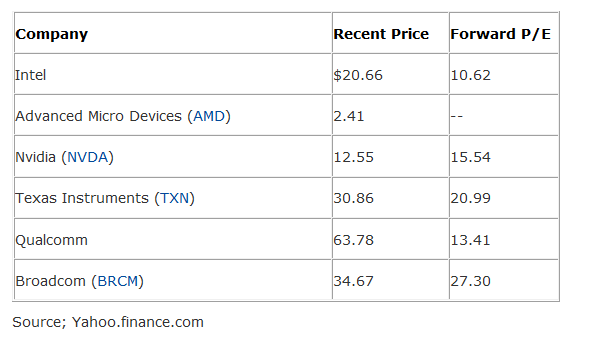
STOCK PICK:  Nvidia


9:46:20 PM] Stephen Shiao: Price: dropped 20% in past 2 months, but forecast is bullish at Q2 earning (in August). Q4 expected $1.01~$1.26B. Current at 5% of 52 week low.
 
[9:47:19 PM] Stephen Shiao: Apple: 15" iMac (4-5M units/yr) come with Kepler line of GPU.
 
[9:48:29 PM] Stephen Shiao: Mobile/Tablet: Tega 3 SoC powered Google Nexus 7, Amazon Kindle File + HD, Segment as low end priced ($199 ~ $249), because Apple iPad-Mini priced $329
 
[9:50:33 PM] Stephen Shiao: PC: HP/DELL will follow Apple use GeForce
 
[9:51:19 PM] Stephen Shiao: Game: GeForce, 60% faster.
BUS600 ProSem: Chapter 5 - Quantitative Analysis

I learned a couple concepts in Quantitative Analysis
  • Decision Trees - A way to graphically show and quantify multiple outcomes of a business decision
  • Sunk Cost - Investment made in the past that have no bearing on future investment decisions
1. Decision Trees:  Below is a schematic example that illustrates the basic element of decision trees.


2. Sunk Cost:
What is a "sunk cost"? What is the definition of a "sunk cost"? What does the term "sunk cost" mean?

"Sunk cost" is a business term that refers to a cost that has been spent and can not be recovered.

Example 1: A company decides to spend $30,000,000 building a new warehouse.

After spending $15 million on the construction of the newA warehouse, with similar specs to the one that the company is currently building, is listed at a price of $10 million.

The company has "sunk costs" of $15 million (this amount can't be recovered, as the new warehouse is incomplete and can't be sold).

From an economic standpoint, the smart decision would be for the company to abandon the construction of their new warehouse and buy the one that is being listed for $10 million.

However, sunk costs usually incur a form of "emotional investment", and many people have a hard time walking away from something once they have incurred costs that can not be recovered.  warehouse, the real estate market in the area begins to tank due to a very weak economy.


BUS600 ProSem: Chapter 4 - Organizational Behavior


The following tree structures illustrated how a large organizational behavior.

BUS600 ProSem: Chapter 3 - Accounting


The Balance Sheet: The listing of what a company owns and owes at a point in time

The Statement of Cash Flows: The summary of how a company generates and uses its cash during a period of time

Opinion: I have learnt some accouting related knowledge from this chapter, such as features of accounts, nature of accounts, analyze the earning, report accuracy, accounting problem, and etc.

Friday, October 5, 2012

BUS600 ProSem: Chapter 2 - Ethics


Stakeholder Analysis - A framework considering who is affected by a business decision

Stakeholder analysis is an essential part of developing a useful Engagement Plan. A common method of stakeholder analysis is a Stakeholder Matrix. This is where stakeholders are plotted against two variables. These variables might be plotting the level of ‘stake’ in the outcomes of the project against ‘resources’ of the stakeholder. Another is the ‘importance’ of the stakeholder against the ‘influence’ of the stakeholder. The concept is the same, though the emphasis is slightly different

BUS600 ProSem: Chapter 1 - Marketing

The key marketing concepts I learned:

The 7 Steps of Market Strategy Development
  1. Consumer analysis
  2. Market anaysis
  3. Competitive analysis
  4. Distribution channel analysis
  5. Develop the marketing mix
  6. Determine the economics
  7. Revise
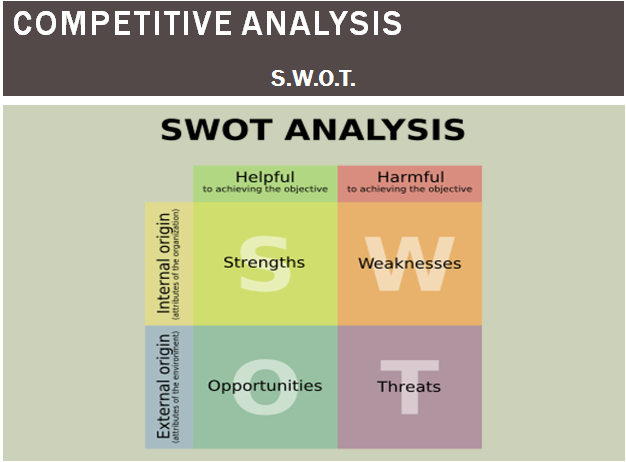
SWOT Analysis - competitive analysis of strengths, weakness, opportunities, and threats