Sunday, July 22, 2012

BUS528 Project Management: Chapter 8

The Art and Science of Accurate Estimating

Estimating will never be a science that produces 100 percent accurate results. Complete accuracy requires the project manager to forecast the future and to be in control of all project variables. but estimates can be sufficiently accurate to support good business decisions. 

  • It takes time and cost money to develop accurate estimates
  • Every technique gives better result when it is used consistently
  • Comparing actual performance to estimates is essential to refining the estimating model
  • Many of the techniques work together. The art of estimating is knowing when to use which technique
  • The variables that make estimates wrong are often beyond the control of the project team
  • It's apparent that project managers working independently never create accurate, useful estimation processes.

Example: Calculate labor and schedule using the project plan with resource spreadsheet

FINANCE: Chapter 6 - Planning Capital Expenditure
  1. The Objective: maximize Wealth (pg 165)
    • For-profit companies, wealth is monetary
    • A project creates wealth if it generates cash flows over time that are worth more in present value terms than the initial setup cost.
    • The goal of any publicly-owned firm should be maximize the wealth of the investors.
  2. Computing NPV: Project Cash Flows (pg 166)
    • Cash is the monarch (king or queen, take your pick).
    • Accounting profit can be changed by judgments, opinions, and management decisions.
    • Cash flow is not so easy to manipulate because cash is visible and real.
  3. Guiding Principles for Forcasting Cash Flow (pg 170)
    • Principal No. 1: Focus on Cash Flow
    • Principal No. 2: Use expected Values
    • Principal No. 3: Focus on the Incremental
  4. Computing NPV: The Time Value of Money (pg 172)
    • The concept that future cash flows have a lower present value and the set of tools used to discount future cash flows to their present values are collectively known as time value of money (TVOM) analysis.

Sunday, July 15, 2012

BUS528 Project Management: Chapter 7

Realistic Scheduling

"Chapter 7 Ideas"

The planning model in this chapter portrays the step-by-step mothod of building a detailed plan. Laying out a detailed plan may not solve all the problems you'll face as a project manager, but it does provide a tool set for solving many of them.

  • Finish-to-start relationship states that one task must be completed before its successor task can begin. The network diagrams in this chapter all follow this simple assumption because it is the most common, but there are toher types of relationships.

  • Tasks with start-to-finish (SS) relationships allow the sucessor task to begin when the predecessor begins.

  • Finish-to-finish (FF) tasks can start independently of each other, but the successor cannot finish unitil the predecessor finishes.

Examples below show the value of using these other types of task relationships.


FINANCE: Chapter 5 - Capital Structure

  1. Risk and Return (pg 129)
    • The relationship between risk and return is one of the fundamental relationship in finance, because investors are risk averse, meaning they prefer less risk to greater risk.
    • Investors who are risk averse will not invest in risky securities without greater expected returns.It means that to earn greater expected returns investors must be willing to accept greater risk.
  2. Portfolio Risk (pg 134)
    • Investors typically hold a collection or portfolio of assets, we need examine the risk of the portfolion context
    • Risk and return in a portfolio is very different from stand-alone risk and return due to diversification effects.
    • First examine the return of portfolio, then consider the risk of a portfolio
  3. Capital Asset Pricing Model (pg 138)
    • The measure of risk most commonly used in the single-factor CAPM is called beta (β).
  4. Cost of Capital (pg 142)
    • Capital includes funds supplied to the firm by long-term investors.
      • These are usually stockholders and bondholders.
  5. Cost of Debt and Equity Capital (pg 143)
    • The cost of debt is the interest rate the firm would pay if it issued new debt today.
    • Usually the firm will pay about the market interest rate (yield to maturity) on its bonds.
FINANCE: Chapter 4 - Discounted Cash Flow


  • Financial assets are substitutes for each other.
  • That implies that they have some properties in common, but will be differentiated in other dimensions
  • A substantial piece of this course is learning how to use Excel.
  • Use Excel for basic arithmetic operations:
     +, -, *, / (with occasional SUM()).
  • This chapter makes heavy use of many Excel functions.

  1. Time Value of Money (pg 103)
    • If I owe you a sum of money, would you rather receive it today or a year from today? The time value of money refers to wht the value of a dollar amount is today (present value) versus what the value of that same dollar amount will be in X amount of time (future value)
  2. Future Value (pg 103)
    • The future value (FV) of this security is its value after a specified time has passed
    • In this case the future value is $100+(0.05)($100)=$105.
  3. Present Value (pg 108)
    • The future value of any sum today is FV = PV x (1 + I)N. That means PV = FV/(1 + I)N
    • What is the amount that we need to invest or deposit today in order to have a specific amount in the future?
  4. Annuities (pg 111)
    • Annuities meet three criteria:
      • Pay an equal amount
      • At a specific time interval
      • For a specific time period


Sunday, July 8, 2012

BUS528 Project Management: Chapter 6


Work Breakdown Structure: Break Your Project into Manageable Units of Work


Class Lecture


"Chapter 6 Ideas"

In this chapter, I pick up ideas on how to build a good work breakdown structure (WBS):-
  1. Begin at the top
  2. Name all the tasks required to produce deliverables
  3. How to organize he WBS
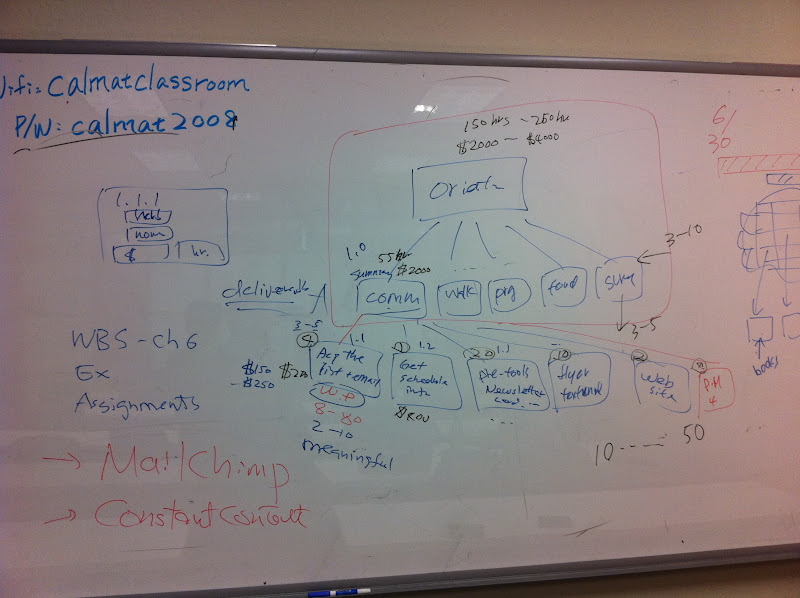
The work breakdown structures breaks the projects down into many small, manageable tasks called packages. The process of deciding who will perform these tasks and how they will be arranged provided the structure for the actual work of the project.


Many project managers relied on the WBS. Estimating, scope management, sub-contracting work, tracking progress, and giving clear work assignments all depend on a well-defined breakdown of the tasks that make up a project. In some way, project managers can use the WBS to solve every problem that they encountered.


Criteria For A Successful Work Breakdown Structure

  1. WBS must be broken down starting at the top. It is a top-down decomposition
  2. Work packages must add up to the summary task.
  3. Each summary task and work package must be named as an activity that produces a product. It means giving each task a descriptive name that includes a strong verb - the activity - and a strong noun - the product. Wihtout these, the task becomes ambiguous.
Here's The Work Breakdown Structure (WBS) For Our Group "New Student Orientation" Project


BUS528 Project Management: Chapter 5

Risk Management: Minimize the Threats to Your Project


A. "Chapter 5 ideas"

During managing a project, there is always uncertainty about the schedule, the costs, the quality of the end product, and many times are the people. In this chapter, I learned there are 5 ideas to minimize the threats to my project.
  1. Identify the risks
  2. Analyze and priotize the risks
  3. Develop response plans
  4. Transfer the risk
  5. Mitigate the risk


B. Risk Analysis Template, identify at least two risks


Based on the above Risk Analysis template, identify:-
  1. Define the risk condition and seriousness
  2. Probablility of the risk level
  3. Risk response strategy and its contingency plan

C. Develop Response Plans:
5 categories of classic risk response strategies, accepting, avoiding, contingency plans, transferring, and mitigating the risk.


  1. Accepting the risk - A common strategy, as long as the consequences are cheaper than the cure
  2. Avoid the risk - Avoiding risks on projects can have the same effect > lower risk, lower return
  3. Contingency Plans - Contingency plan can be looked on as a kind of insurance policies, can be expensive
  4. Transfer the risk - Major component of this strategy is effective contracting and subcontractor management
  5. Mitigating the risk - Mitigation covers all the actions the project team can take to overcome risks from project environment.